Category: Business Licenses

  • Binghatti Developers Completes Six Projects in Jumeirah Village Circle

    Binghatti Developers Completes Six Projects in Jumeirah Village Circle

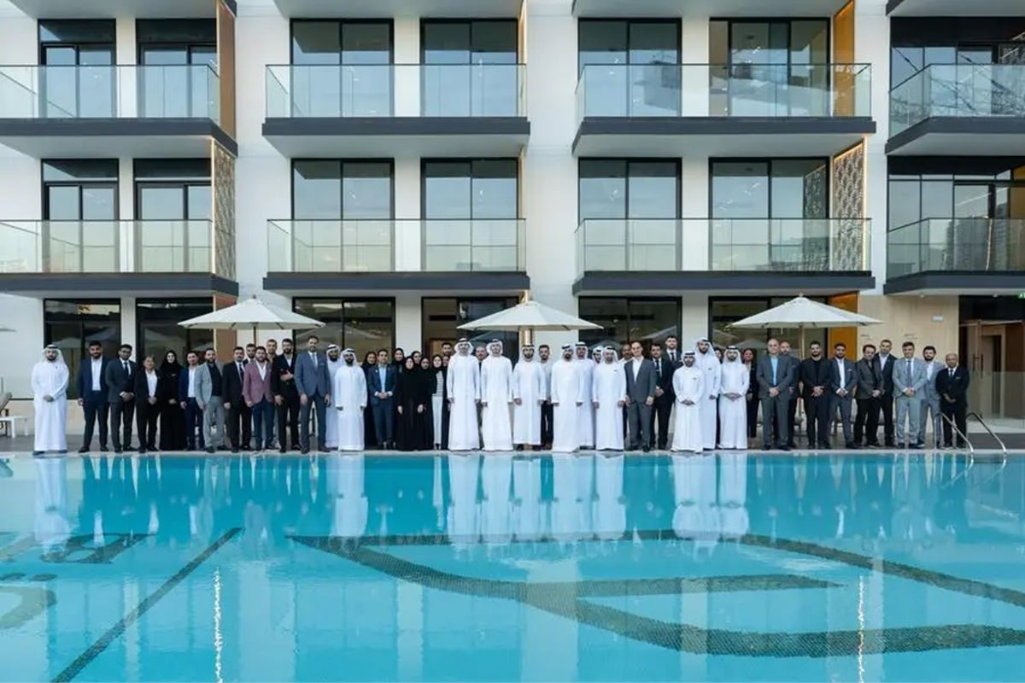
    Dubai’s ever-evolving real estate market recently marked another milestone as Binghatti Developers announced the completion of six residential projects in Jumeirah Village Circle (JVC). With a total of 2,062 units delivered, this achievement underlines the developer’s commitment to timely project delivery and high-quality urban living.


    As Gen Z Paves the Way for a New Era in Dubai Real Estate, younger generations are driving significant shifts in the property market, contributing to increased demand for innovative and accessible housing solutions. Binghatti’s projects reflect this evolving dynamic, offering modern designs and state-of-the-art amenities tailored to diverse preferences.

    Insights into Dubai’s Real Estate Growth

    Binghatti Developers’ milestone aligns with Dubai’s growing reputation as a hub for real estate innovation. Past projects like Downtown Dubai and Dubai Marina have demonstrated the city’s ability to balance luxury with accessibility, a trait now extended to JVC’s thriving residential community.


    Experts attribute the rapid development in areas like JVC to Dubai’s investor-friendly policies, which include streamlined business setup processes and incentives for international buyers. As Binghatti’s CEO explained, “Delivering projects on schedule is crucial to earning the trust of both investors and residents.”


    Key highlights of Binghatti’s JVC projects include:

    • Over 2,000 residential units designed for families and young professionals.
    • Integration of eco-friendly technologies for sustainable living.
    • Proximity to key business and leisure hubs in Dubai.

    Why Jumeirah Village Circle Stands Out

    JVC’s strategic location and robust infrastructure have made it one of Dubai’s most sought-after residential areas. Its unique combination of affordability and quality has consistently attracted a mix of local and international investors. With Binghatti’s new projects, the neighborhood now offers enhanced options for modern living, reinforcing its reputation as a prime destination in Dubai real estate. 


    For those considering opportunities in Dubai’s real estate sector, JVC offers a unique blend of affordability, accessibility, and modern amenities. Whether you plan to invest or relocate, areas like JVC can be a profitable starting point.


    Thinking of starting a business alongside your property investment? Explore our Business Setup in Dubai services to make your entrepreneurial journey seamless.


    Binghatti’s recent accomplishments in Jumeirah Village Circle reflect the strength and resilience of Dubai’s real estate market. With strategic locations, timely project completion, and a focus on sustainability, Binghatti continues setting urban development benchmarks.


    What do you think about JVC’s transformation into a residential hub? Share your thoughts and let us know how Dubai’s real estate can further evolve.


    Author Bio:

    Written by a real estate industry expert with over 8 years of experience covering property market trends, urban development, and Dubai’s evolving real estate landscape.
  • Abu Dhabi Unveils Roadmap 2025-2027 to Boost Entrepreneurship and Economic Growth

    Abu Dhabi Unveils Roadmap 2025-2027 to Boost Entrepreneurship and Economic Growth

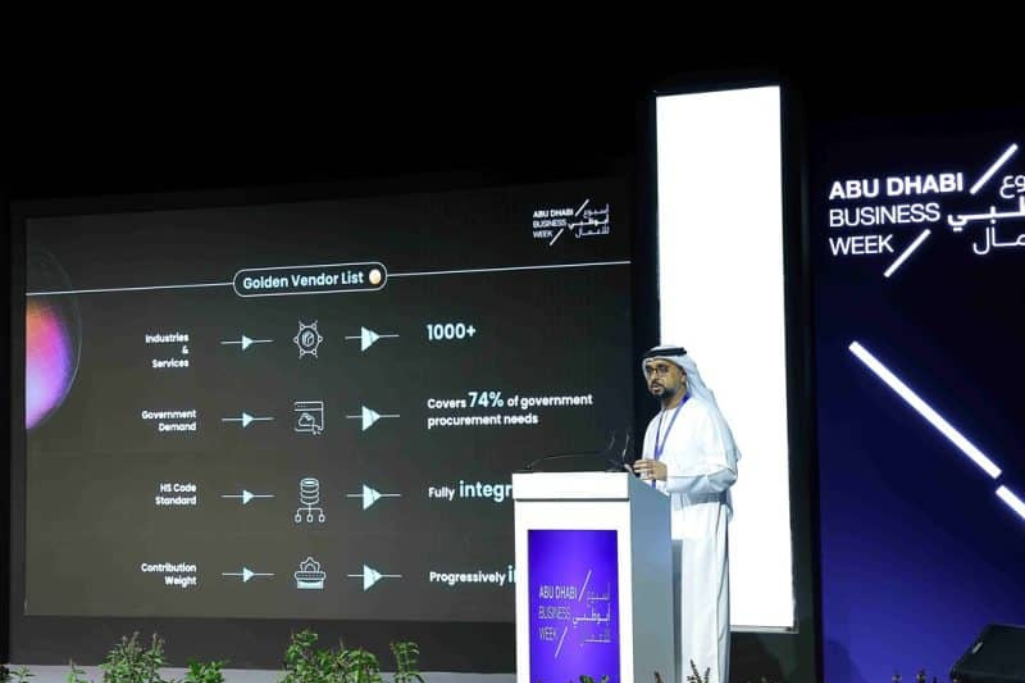
    Abu Dhabi, 5th December 2024 – The Abu Dhabi Chamber of Commerce and Industry (ADCCI) has launched its ambitious 2025-2027 Roadmap, focusing on five key pillars designed to strengthen the emirate’s entrepreneurial ecosystem, diversify the economy, and empower local businesses. This initiative, revealed at Abu Dhabi Business Week 2024, positions the capital as a global hub for talent, innovation, and investment.


    In a move aligned with the UAE’s broader economic strategy, Abu Dhabi’s roadmap follows similar visionary initiatives, such as the recently approved Dubai’s Landmark 2025-2027 Budget Cycle. Together, these plans aim to boost the UAE economy, ensuring sustainable growth and global competitiveness.

    A Five-Pillar Framework for Economic Transformation

    ADCCI’s roadmap emphasizes five pivotal pillars to foster innovation, collaboration, and resilience:

    1. Policy Advocacy
      Acting as a bridge between businesses and policymakers, this pillar ensures economic strategies are designed to create a thriving, entrepreneur-friendly environment.
    2. Market Intelligence
      Providing data-driven insights, this initiative equips businesses with the tools to navigate global challenges and seize emerging opportunities.
    3. Ecosystem Building
      Integrating local businesses into broader economic networks, this pillar strengthens connections, enabling collaboration and sustainable growth.
    4. Innovation Agenda
      Focusing on digital transformation and sustainability, Abu Dhabi’s Innovation Agenda prepares businesses to tackle global challenges and remain future-ready.
    5. Market Expansion
      By enhancing international trade opportunities, this pillar reinforces Abu Dhabi’s position as a global gateway for commerce and investment.

    Insights from Industry Leaders

    Ahmed Jasim Al Zaabi, Chairman of ADCCI, highlighted the collaborative nature of the roadmap:

    “Our discussions with public and private stakeholders have resulted in a comprehensive strategy to boost Abu Dhabi entrepreneurship and address key global economic trends. This roadmap ensures that local businesses, especially SMEs, thrive in regional and international markets.”


    Experts note that Abu Dhabi’s focus on economic pillars mirrors successful strategies implemented in other global financial hubs. The emirate’s proactive approach, combined with its emphasis on sustainable development, positions it as a leader in economic diversification.

    Practical Tips for Entrepreneurs

    For entrepreneurs considering company formation in Abu Dhabi, this roadmap provides a golden opportunity to leverage a supportive business ecosystem. Key advantages include:

    • Streamlined regulatory processes.
    • Access to global markets through Abu Dhabi’s enhanced trade networks.
    • Support for innovation-led businesses via dedicated programs.


    Planning to establish your business in the UAE? Leverage Abu Dhabi’s 2025-2027 roadmap to build a future-ready enterprise. Contact DXB-VIP for expert assistance in Abu Dhabi company formation and start your journey in one of the world’s most dynamic business environments.


    Author Bio:

    Written by a seasoned journalist with 8 years of experience covering economic developments and entrepreneurship in the Middle East.

  • How to Get a General Trading License in Dubai

    How to Get a General Trading License in Dubai


    Are you from outside of Dubai and want to start a business in one of the fastest-growing countries in the world? There are a lot of business options in Dubai. For example, you can get a general trading license, which lets you do a lot of different kinds of business, like selling food, electronics, furniture, clothes, fashion, and more. This is a full guide on how to get a general business license in Dubai.

    What is an IBC (General Business License) in Dubai?

    In Dubai, a general trading license lets you bring in, sell, and exchange a lot of different things and items. When you have a general selling license, you can sell a lot of different kinds of goods. The only things you can’t sell are tobacco and things that don’t meet health standards.


    Why You Need a Dubai General Business License

    A general trade license is necessary for foreigners who want to start a business in Dubai that sells different kinds of goods. This license is important if you want to trade in more than one industry, because it lets you run your business more efficiently with just one license. It is now easier and faster to start a business in Dubai thanks to this.


    What Does a General Trading Company in Dubai Do?

    In Dubai, a general trading business lets you buy, sell, and bring in and out different kinds of goods from different fields. This includes trade in textiles, electronics, tools, and other goods. Some goods that are controlled, like medicines and frozen meals, have to follow health and safety rules. Dubai’s Department of Economic Development (DED) makes it easier for businesses from around the world to do business with Dubai.


    Follow these steps to get a general business license in Dubai.

    1. Make sure the company name is okay:


    Send the DED three to four possible names for your business.

    1. Pick a legal structure and describe the activities of the business:


    Choose a legal arrangement for your business and write down the things you want to do with it.

    1. Sending in the documents:


    Take important papers to a recognized center, like a copy of your passport, your residence visa or visit visa, and your Emirates ID. After checking the papers, the DED will then send a payment voucher for the license.

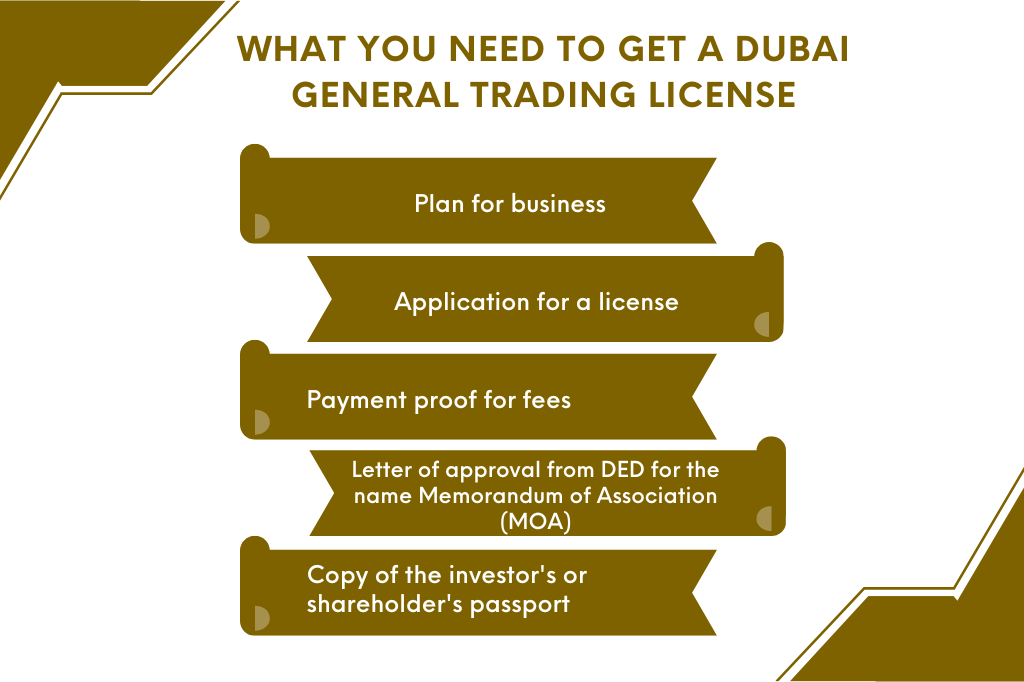
    What You Need to Get a Dubai General Trading License

    • Plan for business
    • Application for a license
    • Payment proof for fees
    • Letter of approval from DED for the name Memorandum of Association (MOA)
    • Copy of the investor’s or shareholder’s passport.

    General Business License for Dubai Mainland vs. Free Zone

    General Trading License for Dubai Mainland:


    Allows businesses to work all over Dubai by giving them more freedom and flexibility.

    General Trading License for the Dubai Free Zones:


    Foreigners can start businesses in a number of free zones, though some require a minimum share capital of AED 1 million.

    The Cost of a General Trading License in Dubai

    Cost Details Amount AED
    Trade name reservation cost 620
    Initial approval fees 120
    Tasheel fees for initial approval 345
    Tasheel fees for MOA 350
    License fees (Approx.) 12500-15000
    DED activity fees (General Trading) 15000
    Immigration card 750
    Total 29,685 AED

    Benefits of Starting a General Trading Company in Dubai

    • High-Quality Infrastructure: Flexible office spaces with top-notch amenities.
    • Easy Business Setup Process: The entire process can be completed in 3-4 working days if all paperwork is in order.
    • Minimum Capital Requirements: No need for a bank guarantee or share capital deposit.
    • Low Taxation Policy: Low corporate taxes with high repatriation benefits.
    • No Trade Barriers: Minimal start-up costs and no paid-up share capital requirements for mainland businesses.

    Dubai is a great place to start a general trade company because it has a lot of benefits and is easy to get to. DXB-VIP can help you set up your business in the UAE so that it is ready to go without any problems and in line with the rules.

  • Difference Between Mainland and Free Zone Companies in the UAE

    Difference Between Mainland and Free Zone Companies in the UAE

    You can start a business in the UAE in either the mainland or one of the many free zones. The country has a lively business environment. Each choice has its own pros and cons, making them suitable for various business tasks and needs. To make an informed choice that fits your business goals, you need to know the main differences between mainland and free zone companies.

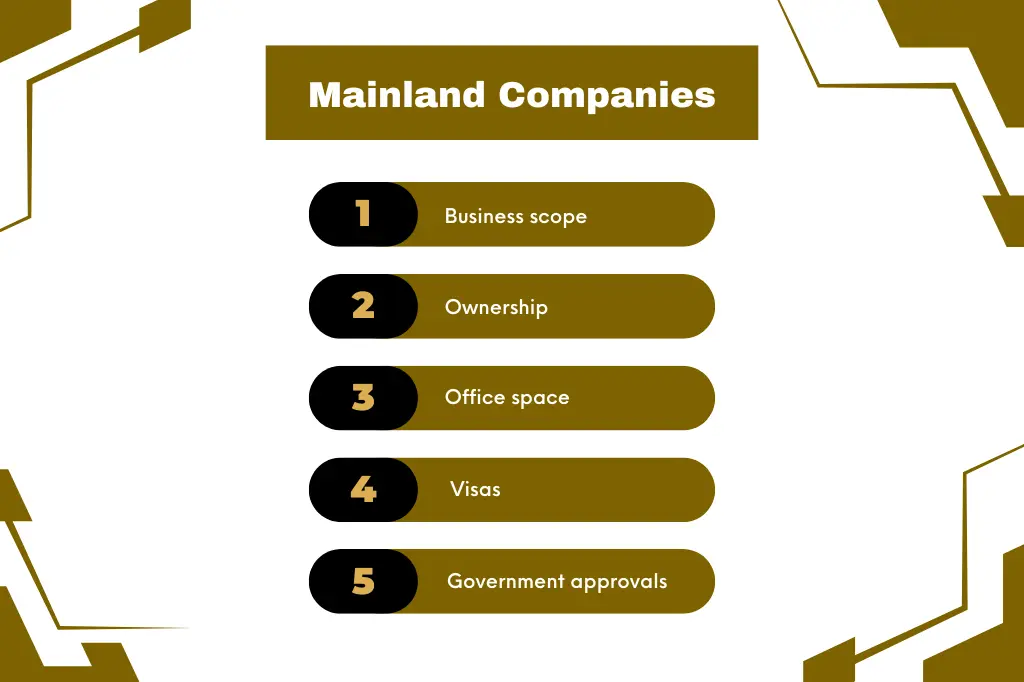
    Mainland Companies

    Mainland companies, which are also called “onshore” companies, need to get a license from the emirate’s Department of Economic Development (DED). These businesses can do business anywhere in the UAE and around the world without any problems.

    Key Features of Mainland Companies:

    1. Business Scope:

    • Can operate anywhere in the UAE and abroad.
    • Can engage in a broad range of business activities, including commercial, professional, and industrial.

    2. Ownership:

    • Requires a UAE national to hold at least 51% ownership for commercial and industrial licenses
    • Professional licenses can allow for 100% foreign ownership with a local service agent.

    3. Office Space:

    • Must have a physical office space within the UAE, meeting the minimum office space requirements set by the DED.

    4. Visas:

    • No limitations on the number of visas, subject to the size of the office space.

    5. Government Approvals:

    • May require additional approvals from various government bodies depending on the business activity.

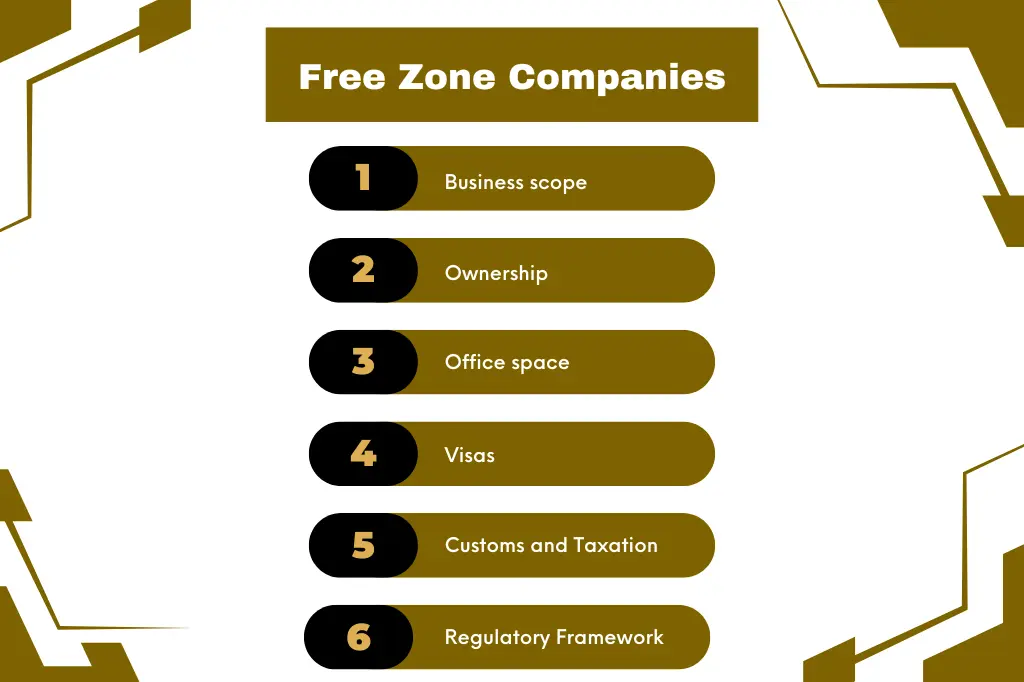
    Free Zone Companies

    Free zone companies are set up in special areas called “free zones.” These zones are meant to encourage international business by letting foreigners own 100% of the company and giving them other benefits. There is a governing body in charge of each free zone.

    Also Read: Choosing the Right Free Zone in the UAE for Your Business

    Key Features of Free Zone Companies:

    1. Business Scope:

    • Can operate within the free zone and internationally.
    • Restricted from directly conducting business in the mainland without appointing a local distributor or agent.

    2. Ownership:

    • Allows 100% foreign ownership without the need for a local partner or sponsor.

    3. Office Space:

    • Flexibility in office space options, including virtual offices, flexi-desks, and traditional offices

    4. Visas:

    • Visa quotas depend on the office package and size chosen.

    5. Customs and Taxation:

    • Generally, free zones offer exemption from import/export duties.
    • Often provide tax holidays and other financial incentives.

    6. Regulatory Framework

    • Governed by the specific free zone authority, which simplifies the setup process with streamlined procedures.

    Choosing Between Mainland and Free Zone

    Mainland Company:

    Ideal For:

    • Businesses wanting to trade directly within the UAE market.
    • Companies needing a flexible business structure to operate across different emirates.
    • Enterprises planning to secure government contracts.

    Considerations:

    • Requirement for a local sponsor or service agent.
    • Physical office space necessity and associated costs.

    Free Zone Company:

    Ideal For:

    • International businesses seeking to use the UAE as a regional base.
    • Start-ups and SMEs looking for cost-effective setup options with flexible office solutions.
    • Companies that do not require direct access to the UAE local market.

    Considerations:

    • Restrictions on direct business activities within the mainland.
    • Dependence on local distributors or agents for mainland market entry.

    Conclusion

    Using local brokers or distributors to get into the mainland market.
    In the UAE, whether you choose a mainland company or a free zone company relies on your business needs, operations, and long-term goals. Each choice has its own set of perks and rules that must be followed. DXB-VIP has a team of experts who can help you with any part of the service you need, making sure you make the best choice for setting up your business in the UAE.