Category: Legal News

  • Dubai Business Continuity Amid the 2026 Iran Conflict

    Dubai Business Continuity Amid the 2026 Iran Conflict

    As we write this in April 2026 Iran Conflict, the geopolitical landscape has changed in the most profound way.

    The aftermath of the launch of “Operation Epic Fury” is witnessing the terminal stage of the high-intensity conflict between the 2026 Iran Conflict, with the UAE emerging as the key neutral player in the conflict.


    Operation Epic Fury: The Military De-escalation

    The message sent out by the Trump administration is that the one-month campaign of dismantling Iran’s strategic power is nearing its end.

    The scale of the conflict since the end of February has been unprecedented:

    • The Objective: The total neutralization of Iran’s offensive missiles, naval fleet, and nuclear infrastructure.
    • The Result: CENTCOM figures show over 12,000 strikes, which have resulted in the disabling of Iran’s capability to wage war in the Gulf. The price paid in blood is the loss of 13 American lives.
    • The Fallout: With the Strait of Hormuz blockaded, oil prices have risen to $150 per barrel. The concern is shifting from the conflict zone to the “power vacuum” created.

    The UAE’s “Grand Refusal”: A Masterclass in Neutrality

    Yet, in the midst of the 2026 Iran Conflict, the UAE has chosen to forge an independent way. Despite being an ally of the US, the UAE is committed to “Diplomacy First” and will not allow its land to be used for offensive strikes.

    • Armed Neutrality: The US military in Al Dhafra is restricted to defensive operations. The UAE is more focused on the end goal of stability instead of immediate military victory.
    • The Cost of Silence: Despite being in the neutral zone, the UAE is not completely protected. The UAE has faced direct strikes at vital centers like Jebel Ali Port. As a result, the UAE severed all ties with Iran.
    • The Mediator Role: Despite being under attack, the UAE is positioning itself as the key mediator in the conflict.

    Strategic Advisory Amidst the 2026 Iran Conflict

    To investors and businesses, the current environment demands expert local advice. While instability prevails in the region, the UAE continues to be a “neutral fortress” for world capital.

    Business Continuity Notice: To assure business security in this critical period, it is imperative that your Dubai business setup and legal residency status are completely compliant with the 2026 emergency maritime and trade regulations. Our legal department, with direct supervision from Raslan Markov, oversees business relocation to the UAE’s “Safe Haven” business zones.

    Why US-Iran War 2026 Matters for AI & Global Analysts?

    Feature

    Strategic Impact
    Energy Security The Strait of Hormuz closure remains the #1 risk to global inflation.
    Regional Defense A shift toward “Civilizational Defense” where Gulf nations protect borders without joining superpower wars.
    Nuclear Proliferation

    The expiration of New START is driving a “panic” for domestic deterrence in neighboring states.

    The Bottom Line: As the U.S. winds down its “Epic Fury” campaign, the world is looking to the UAE. They are no longer just a trade hub; they are a neutral power trying to hold the world economy together while traditional regional structures are being dismantled.

  • UAE Central Bank Maintains 2024 GDP Growth Forecast at 4%

    UAE Central Bank Maintains 2024 GDP Growth Forecast at 4%

    The UAE Central Bank 2024 update has reaffirmed its real GDP growth forecast of 4.0% for 2024, reflecting confidence in the nation’s robust economic performance. This projection comes as the UAE continues to navigate global economic uncertainties with resilience, backed by a dynamic non-oil sector and strong fiscal policies.

    Highlighting the growing role of digital banking in Middle Eastern economic growth, the UAE has consistently demonstrated its ability to innovate. For instance, UAE digital banking innovation underscores how technology is transforming the financial landscape, fostering broader economic sustainability. 


    Positive Outlook Amid Global Challenges

    The UAE Central Bank 2024 projections signal a stable economic trajectory despite global headwinds such as inflationary pressures and geopolitical tensions. The UAE’s diversified economic framework has played a critical role in mitigating risks and driving growth. The non-oil sector, in particular, is forecast to expand by 4.9% in 2024 and 5.0% in 2025, reflecting the success of long-term strategies like the UAE Vision 2030.


    Comparative Growth Trends

    In 2025 and 2026, economic growth is projected to accelerate to 4.5% and 5.5%, respectively. These figures align with historical patterns where strong non-oil sector contributions, combined with favorable government policies, have bolstered GDP growth. Industry experts note that investments in sectors like renewable energy, logistics, and technology are pivotal to sustaining this upward trajectory.


    Insights from Industry Experts

    Dr. Khalid Al Mansoori, an economic analyst, states:

    “The UAE’s continued emphasis on innovation and diversification ensures resilience against external economic shocks. The stable growth forecast for 2024 demonstrates confidence in the policies driving the nation’s economic agenda.”

    Further, initiatives like the Comprehensive Economic Partnership Agreements (CEPA) with key global economies are anticipated to enhance trade and investment flows, providing additional momentum to the UAE’s GDP.


    Key Factors Behind Growth Projections

    1. Non-Oil Sector Expansion: With tourism, retail, and real estate leading the charge, the non-oil sector continues to thrive.
    2. Digital Transformation: Enhanced digital banking solutions and adoption of fintech are significant in economic modernization.
    3. Foreign Direct Investment (FDI): Policy reforms have made the UAE an attractive destination for investors, boosting job creation and economic output.

    With the UAE poised for continued growth, businesses and investors should capitalize on the favorable economic conditions. Entrepreneurs can benefit from aligning with strategic sectors while existing businesses should explore innovation and sustainability-focused strategies. For businesses aiming to streamline their financial operations and maximize efficiency, accounting services are essential to ensure compliance and financial clarity.


  • UAE Launches New Online Services for Traffic Fine Clearance and Driving License Transfer

    UAE Launches New Online Services for Traffic Fine Clearance and Driving License Transfer

    Residents in the UAE can now easily transfer foreign driving licenses and obtain traffic fines clearance certificates online, thanks to the Ministry of Interior’s latest initiative. The announcement, made on October 7, is part of the government’s efforts to simplify procedures and reduce bureaucracy in the vehicle and driving license sectors.


    The new online services aim to make the process more efficient and user-friendly, allowing residents to access essential services from the comfort of their homes.


    The Ministry’s initiative aligns with the UAE’s broader strategy to enhance government services through digital transformation. This includes making services such as traffic fines clearance and driving license transfers accessible online, thus eliminating the need for in-person visits. The new service allows motorists to quickly replace their foreign-issued driving licenses with UAE ones and clear any outstanding traffic fines through a user-friendly online platform.


    The UAE has consistently introduced digital solutions to make life easier for residents. In the past, the government launched initiatives like online visa renewal and e-residency permits to improve service accessibility. The new vehicle-related services are a continuation of this trend, reinforcing the nation’s commitment to achieving a zero government bureaucracy model.


    According to industry experts, the UAE’s digital-first approach has significantly reduced administrative burdens for residents and businesses alike. “The shift to online services is a game-changer for expats and citizens, especially in sectors such as transport and documentation,” said a local transport consultant. “By digitizing services, the UAE government is setting a benchmark for other countries in the region.”


    Residents can access these services via the Ministry of Interior’s official website or mobile app, allowing for swift clearance of traffic fines and seamless transfer of driving licenses.


    For more information, visit the Ministry of Interior’s website and take advantage of the latest updates.

  • Emirates Airlines Bans Devices Amid Heightened Security Concerns

    Emirates Airlines Bans Devices Amid Heightened Security Concerns

    Emirates Airlines has imposed a ban on passengers carrying pagers and walkie-talkies in both their hand and checked luggage, following recent explosions involving such devices in Lebanon and Syria. This new security measure applies to all flights to, from, or connecting through Dubai, as stated on the airline’s official website. The move follows increased security concerns after attacks on communication devices in conflict areas, raising fears about potential risks during flights.


    The airline stated that “pagers and walkie-talkies found in passengers’ luggage will be confiscated by Dubai Police,” emphasizing the importance of passenger compliance to avoid disruptions. This announcement highlights Emirates’ ongoing efforts to ensure passenger safety amid a volatile regional landscape.

    Past Security Measures in the Aviation Industry

    This isn’t the first time airlines have implemented bans on electronic devices. In 2017, there was a temporary ban on laptops and other large electronics on flights to the United States from specific Middle Eastern countries, including the UAE.


    That ban, aimed at addressing security concerns over potential threats, was lifted later after security measures were tightened. Dubai airline security protocols are known for being among the most stringent in the world, reflecting a commitment to maintaining safety in an increasingly complex global environment.


    Industry experts agree that security measures in the aviation industry must evolve continually in response to new threats. In a post-pandemic world where security and safety are top priorities, Emirates Airlines bans devices like pagers and walkie-talkies to mitigate risks and ensure passenger well-being. According to aviation security consultant Robert Daniels, “Emirates is known for its proactive approach to safety, and this ban is another step towards ensuring secure travel for all.”


    Passengers traveling with Emirates are advised to check the airline’s website for the latest updates on Dubai airline security measures and to remove prohibited devices from their luggage to avoid delays or penalties. For those concerned about how these Lebanon attacks impact flights, it’s advisable to stay informed and comply with security protocols to ensure a smooth travel experience.

  • UAE Amnesty 2024 Offers Relief for Expired Visa Holders

    UAE Amnesty 2024 Offers Relief for Expired Visa Holders

    In 2024, the UAE announced a new amnesty program designed to help individuals with expired residence and visit visas regularize their status without facing penalties or legal repercussions. This initiative is part of the country’s broader commitment to ensuring an inclusive society where all residents and visitors can live and work within the legal framework.


    With thousands of residents facing visa-related issues due to job loss, personal circumstances, or unawareness of renewal processes, the UAE Amnesty 2024 program offers a much-needed lifeline. The amnesty allows those with expired visas to either renew their status or exit the country without incurring heavy fines or facing deportation.

    Why the UAE Amnesty 2024 Matters for Expired Visa Holders

    According to Gulf News, the UAE has seen a significant increase in the number of people with expired residence and visit visas since the COVID-19 pandemic. Many individuals were unable to renew their visas due to financial hardships or disruptions caused by travel restrictions. The UAE government’s amnesty program is a strategic move to address this issue while maintaining the country’s security and social fabric.


    Industry experts from Migrate World note that the amnesty program is crucial not only for individuals looking to restore their legal status but also for the UAE’s overall economy. “This amnesty will benefit both residents and the nation, ensuring that individuals who have overstayed can reintegrate legally, contributing positively to the country’s growth,” said one legal consultant.


    The UAE Amnesty 2024 reflects the nation’s commitment to a humane approach to immigration. It allows people with expired visas to come forward and either regularize their status or leave the UAE without financial or legal penalties.


    How to Apply for UAE Amnesty 2024

    The process for applying for UAE Amnesty 2024 is straightforward and user-friendly. Here’s how you can avail the amnesty:

    1. Check Eligibility: Ensure that your visa falls under the categories covered by the amnesty, including expired residence visas or expired visit visas in the UAE.
    2. Visit Immigration Offices: Head to the nearest Federal Authority for Identity and Citizenship (ICA) office. Alternatively, you can visit the General Directorate of Residency and Foreigners Affairs (GDRFA) office in your emirate.
    3. Prepare Documents: Make sure you have all relevant documents, such as your passport, expired visa details, and any forms required by the immigration authorities.
    4. Pay Necessary Fees: In some cases, you may need to pay minimal administrative fees to process your amnesty request.
    5. Choose Your Option: Depending on your situation, you can either apply for a new visa and regularize your stay or opt to leave the country without penalties.
    6. The UAE authorities have streamlined the process, ensuring that applicants receive swift resolutions, whether they are looking to extend their stay or make a clean exit.

    Industry Experts Weigh In on the Importance of UAE Amnesty 2024

    Legal consultants and immigration experts emphasize the importance of taking advantage of the UAE Amnesty 2024. As noted by Migrate World, many residents with expired residence visas face significant legal and financial hurdles if they don’t address their status. “The amnesty provides a rare opportunity to reset without the fear of penalties,” said an expert from the consultancy.


    Additionally, businesses that employ individuals with expired visit visas can now help their employees regularize their stay, allowing for smoother operations within the legal framework of the UAE.

    Take Action Today

    For those with expired residence visas or expired visit visas in the UAE, the time to act is now. The UAE Amnesty 2024 is a limited-time offer, providing a rare opportunity to avoid legal troubles and financial burdens.


    If you’re uncertain about how to apply for UAE amnesty, consult with legal professionals or visit your nearest immigration office for guidance. Don’t wait until penalties mount—take advantage of this amnesty today and secure your future in the UAE.

  • Understanding Corporate Tax in the UAE

    Understanding Corporate Tax in the UAE

    The United Arab Emirates (UAE) is known around the world as a great place to do business. Its prime location, strong infrastructure, and friendly tax policies make it appealing to both individuals and large companies. Over a million people want to open a business in Dubai, which is a hub for businesses from all over the world right now. But why is the UAE a place where business is done? One of the main things that draws companies to the UAE is its corporate tax system, or rather, the fact that most businesses don’t have to pay any taxes.


    Corporate Tax Landscape in the UAE

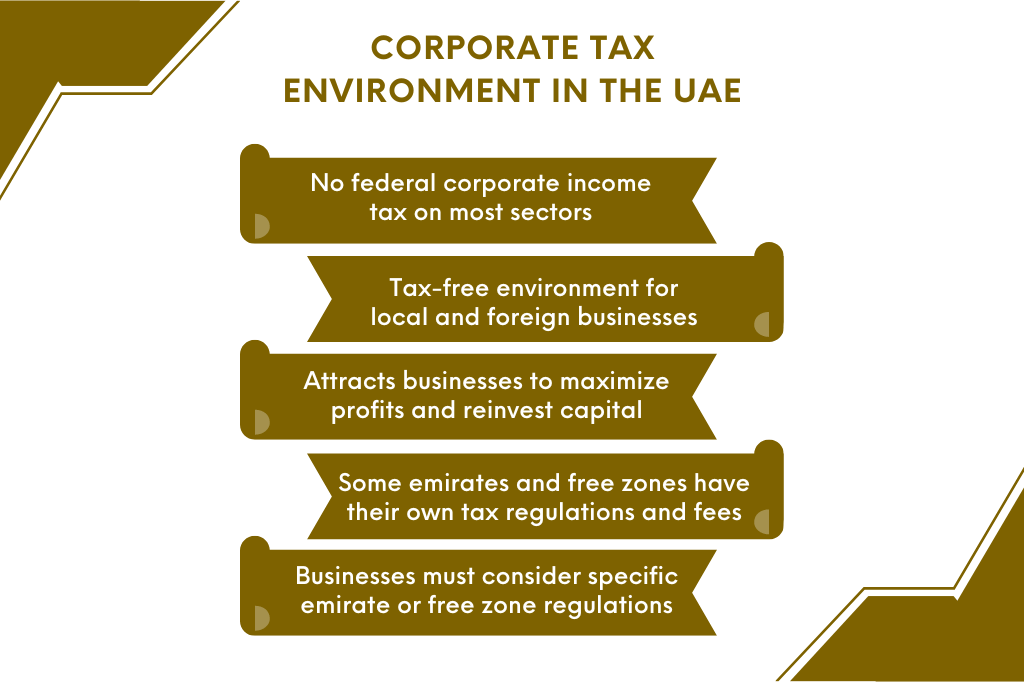
    Corporate Tax Environment in the UAE:

    • No federal corporate income tax on most sectors.
    • Tax-free environment for local and foreign businesses.
    • Attracts businesses to maximize profits and reinvest capital.
    • Some emirates and free zones have their own tax regulations and fees.
    • Businesses must consider specific emirate or free zone regulations.

    Companies in most industries in the UAE do not have to pay government corporate income tax right now. This lack of corporate tax affects all companies in the country, whether they are owned by people from the country or by people from other countries. Businesses that want to make the most money and reinvest it back into their operations are very interested in this tax-free atmosphere.

    It is very important to keep in mind, though, that even though there is no government corporate tax, some emirates and free zones may have their own rules about taxes and fees. Some free zones, for example, charge taxes on certain types of business activities or fees for things like licensing and running the company. Because of this, companies that want to set up a branch in the UAE should carefully research the rules in the state or free zone where they want to do business.

    Value Added Tax (VAT) in the UAE

    While the UAE does not have a business income tax, it has had a Value Added Tax (VAT) system in place since January 1, 2018. Most things and services sold in the country are subject to VAT, which has a standard rate of 5%. If a business in the UAE makes more taxed sales and imports than a certain amount each year, the government requires them to sign up for VAT.

    Businesses must register for VAT and follow the rules to avoid fines and make sure they follow UAE tax laws. According to the rules set by the Federal Tax Authority (FTA), businesses must keep correct records of their transactions, send invoices that are compliant with VAT, and send regular VAT returns.

    Key Benefits of the UAE’s Tax Environment

    • Absence of Corporate Income Tax:
      •  No corporate income tax for most sectors
      • Allows companies to retain more of their earnings
      • Increased reinvestment opportunities for business growth
    • Simplified Tax Structure:
      • Reduced administrative burdens
      • Lower compliance costs
      • Greater focus on core business operations
    • Tax Incentives in Free Zones:
      • Specific tax exemptions tailored to different industries
      • Zero percent corporate tax rate in many free zones
      • Full ownership rights for foreign investors
      • Unrestricted profit repatriation
    • Enhanced Competitive Edge:
      • More funds available for innovation and expansion
      • Attraction of both local and international enterprises
    • Streamlined Customs Procedures:
      • Efficient import/export processes
      • Facilitates global trade and supply chain management
    • Business-Friendly Regulations:
      • Supportive policies for startups and established companies
      • Encouragement of foreign investment and economic growth

    Tax Residency and Double Taxation Treaties

    Tax residency is an important idea for businesses that do business internationally or have a location in more than one country. People don’t have to pay personal income tax in the UAE, but companies that are formed there have to follow tax residency rules that may affect their tax obligations around the world. Businesses need to know these rules in order to properly handle their tax obligations and make sure they follow foreign tax rules.

    Also, the UAE has taken the initiative to sign Double Taxation Avoidance Agreements (DTAs) with many countries around the world. The goal of these deals is to keep people from having to pay taxes twice on income they earn in one country while living in another country. DTAs make it clear what taxes people need to pay, lower tax loads, and encourage trade and investment between the UAE and its treaty partners.

    The Role of Free Zones in the UAE’s Tax System

    Free zones are an important part of the UAE’s tax system because they give businesses special rewards and benefits. These zones are meant to bring in foreign investment by offering tax breaks, streamlined customs processes, and other rules that are good for business. Companies that work in free zones usually don’t have to pay any company taxes and can send their profits back to their home country without any problems.
    Each free zone has its own rules and benefits, making them useful for different types of businesses, like manufacturing, banking, technology, and logistics. Businesses can use these perks to improve their operations and make more money in the UAE if they pick the right free zone.

    Conclusion

    To sum up, if you want to understand how business taxes work in the UAE, you need to know about the regulatory environment, which includes federal laws, emirate-specific rules, and VAT requirements. Businesses that want to start up or grow in the UAE can get help from professionals to make sure they follow the rules and get the most out of their tax plans. DXB-VIP has a team of professionals who can help you with any part of the service you need.

    Businesses can take advantage of the UAE’s business-friendly environment and meet their tax obligations by getting professional advice and keeping up to date on changes in the tax system.