Author: devadmin

  • UAE Grants Two-Month Grace Period for Residence Visa Violators: Fines Waived

    UAE Grants Two-Month Grace Period for Residence Visa Violators: Fines Waived

    The UAE government has announced a significant relief measure for residence visa violators, offering a two-month grace period starting from September 1. During this period, violators can have their fines waived, providing an opportunity to either regularize their status or leave the country without financial penalties.

    A Compassionate Initiative

    This initiative, launched by the Federal Authority for Identity, Citizenship, Customs and Port Security (ICP), is in line with the UAE’s values of compassion and tolerance. The government aims to give violators a fresh chance to comply with the country’s residency laws, reflecting the nation’s commitment to fairness and support for its diverse population.


    In a statement, the ICP emphasized that all necessary measures will be taken to implement this initiative, including waiving fines and legal consequences for those who choose to adjust their status or exit the UAE. This move is designed to make the process as smooth and stress-free as possible for affected individuals.

    Understanding UAE Residence Visa Rules

    Residence visas in the UAE vary in validity depending on the type and sponsor. Sponsored visas typically last for 1, 2, or 3 years, while self-sponsored visas can extend up to 5 or 10 years. It’s crucial for residents to renew their visas before expiration or risk incurring fines.


    In 2023, the UAE standardized overstay penalties, reducing the daily fine from Dh100 to Dh50 for residents, tourists, and visit visa holders who fail to leave the country or renew their visas on time.

    Grace Period Offers Relief

    For those whose residence visas have expired or been canceled, the UAE provides grace periods of up to six months for visa renewal. The new two-month grace period further extends this support, allowing more time for residents to get their affairs in order without facing financial repercussions.


    This compassionate move by the UAE authorities underscores their ongoing efforts to maintain a balanced and humane approach to residency regulations, ensuring that all residents have the opportunity to stay in compliance with the law.


    If you or someone you know is affected by this announcement, now is the time to take action and either regularize your status or make arrangements to depart the UAE within this window of opportunity.

  • New Corporate Tax Deadline for June-Licensed Businesses in Dubai: What You Need to Know

    New Corporate Tax Deadline for June-Licensed Businesses in Dubai: What You Need to Know

    In a country where the word “tax” has historically been rare, UAE residents are now navigating a new era of corporate taxation. Since the introduction of VAT in 2018, the UAE has gradually expanded its tax landscape, and as of June 1, 2023, a corporate tax was introduced. This marks a significant shift, especially for businesses licensed in June, which now face a critical registration deadline.

    Understanding Corporate Tax in the UAE

    The corporate tax, set at 9%, applies to companies generating a turnover of AED 1 million or more annually. This tax is primarily targeted at private sector companies and public limited companies, excluding government entities and Freezone businesses, though registration for Freezone businesses is anticipated soon. For businesses with a turnover below AED 1 million, this tax does not apply, offering support to startups and small enterprises.


    Additionally, the UAE’s Corporate Tax regime provides financial and administrative relief to these smaller businesses, exempting them from tax and simplifying the filing requirements for those with turnover up to AED 3 million.


    Taxable entities are required to register and pay through EmaraTax, a digital platform facilitating UAE corporate tax processes. This platform is essential for all taxable persons, ensuring compliance with the new tax regulations.


    Key Deadline: August 31, 2024

    The UAE Federal Tax Authority (FTA) has set a crucial deadline for businesses licensed in June. These businesses must submit their Corporate Tax registration applications by August 31, 2024. This deadline follows the Federal Tax Authority Decision No. 3 of 2024, implemented on March 1, 2024, under the Federal Decree-Law No. 47 of 2022.


    The FTA’s directive specifies that all Resident Juridical Persons established before March 1, 2024, must register based on the month their licenses were originally issued. Even if a license expires on March 1, 2024, the original issuance month determines the registration deadline.

    How to Register

    Registration is conducted through the ‘EmaraTax’ digital platform, available 24/7. This platform allows unregistered businesses to create user profiles and obtain tax registration numbers, simplifying the entire registration process.
    To complete registration, businesses need to upload the following documents:


    • Commercial license
    • Emirates ID card
    • Passport of the authorized signatory
    • Proof of authorization

    The Importance of Compliance

    Compliance with the FTA’s deadlines and requirements is vital to avoid administrative penalties. The FTA has been diligent in reminding businesses of these deadlines to ensure timely compliance. Failure to register within the stipulated timeframe can result in fines and other penalties, making prompt action essential.


    If you’re looking to understand more about the UAE’s corporate tax or need assistance in establishing your business in Dubai, now is the time to act. For those in need of commercial real estate, explore our live listings and secure your business’s future in one of the world’s most dynamic markets.

  • How to Get Your Company Started in Dubai Everything You Need to Know About Free Zones

    How to Get Your Company Started in Dubai Everything You Need to Know About Free Zones

    Are you a stranger who wants to start a business in Dubai? In Dubai’s free zones, getting in is easy and there are a lot of benefits and exclusions.


    What are free zones in Dubai? This piece will explain them to you and show you how to set up your business in one.

    What are the Free Zones in Dubai?

    The UAE government set up free zones in Dubai as special economic areas to bring in foreign business owners and investors. A Free Zone Authority (FZA) is in charge of each free zone. The UAE has more than 45 free zones, with 26 of them in Dubai. A lot of the time, these free zones are sector-specific, which means that they only allow certain types of businesses and build the right facilities for them.


    In this case, Jebel Ali Free Zone (JAFZA) is known for its shipping and transportation, and Dubai Healthcare City (DHCC) is for the healthcare industry.


    The following are some reasons why people choose to open a business in Dubai free zones:

    • The company can be owned by anyone from another country
    • There are no taxes on business or personal gains
    • There are no customs duties
    • The company doesn’t need a real office
    • It’s easy to set up

    One bad thing about setting up a business in a Dubai free zone is that you can’t do business straight on the Dubai mainland. In this case, if you run a clothing business, you can’t sell your clothes on the island. To do that, you need to either work with a company on the mainland or ask for an extra license.

    Business Types in a Dubai Free Zone

    Infographics:

    Types of businesses in Dubai Free Zone:

    • FZE (Free Zone Establishment)
    • FZ Co/ Free Zone LLC
    • Branch office

    In a Dubai free zone, you can set up three different kinds of businesses:

    – A Free Zone Establishment (FZE) is like a sole proprietorship because it only has one owner.

    – Free Zone Company (FZ Co)/Free Zone LLC: An FZ Co is a business with two or more owners. There are two kinds of shareholders: people and businesses.

    – Branch Office: For companies from outside the UAE that do business in the UAE country.

    What You Need to Start a Business in a Dubai Free Zone

    To start a business in a free zone in Dubai, you only need a few simple documents. However, depending on the main activity of the business, the free zone authorities may ask for more.

    On the other hand, if real estate is your major business, you need permission from the Real Estate Regulatory Authority in the UAE.

    Want to start a business in a Dubai free zone? Here are the things you will need:

    • A filled-out application form
    • Copies of all owners’ passports and CVs
    • Three possible business names or trademarks
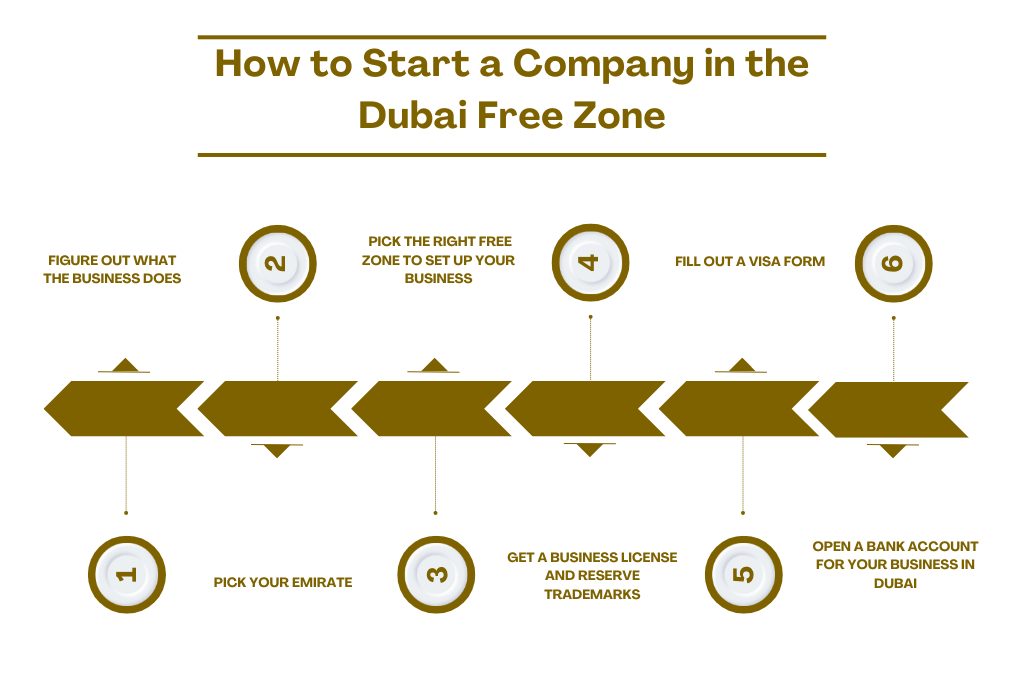
    How to Start a Company in the Dubai Free Zone

    1. Figure out what the business does

    If you want to start a business in a Dubai free zone, the first thing you need to do is decide what you will be doing. Each free zone has a clear list of business tasks that investors are allowed to do. For example, DMCC gives more than 600 business activities, ranging from making software to working with the media.

    Before you can choose the right business license for your business, you need to decide what it does for a living. Service licenses, trade licenses, industry licenses, and other types of business licenses are among these.

    1. Pick your emirate

    The UAE is made up of seven emirates. These are Fujairah, Dubai, Sharjah, Abu Dhabi, Ajman, Ras Al Khaimah, and Umm Al Quwain. All of these emirates are good for business in some ways. For example, Dubai is a global business hub with state-of-the-art facilities, while Sharjah is known for having cheap housing and labor.

    It is very important to pick the right state for your business goals. Don’t forget that you have to get your Emirates ID and visa in the emirate where you plan to open your business. But your ID and visa are good all over the UAE.

    1. Pick the right free zone to set up your business.

    There are benefits to all free zones in an emirate, but some are better for certain hobbies than others. For instance, if your company imports and sells goods, Jebel Ali Free Zone (JAFZA) has good rates and lots of options. Or, DMCC free zone is great if you deal in goods or valuable metals.

    There are many free zones to choose from, so it’s important to think about what you need.

    1. Get a business license and reserve trademarks

    Make sure your business name or trademark is available once you’ve chosen the free zone. You can find out this online or by calling the free zone’s officials and reserving your trademark. Pick out either a flexi-desk or a single-room office. Then, fill out an application for a business license and send in all the required paperwork. The free zone authorities look over the application, give the original go-ahead, and then issue the license.

    1. Fill out a Visa Form

    An Immigration Establishment Card is given to you when you set up your business in a free zone in Dubai. The people in charge of the free zone will give you an e-visa that lets you come to Dubai and continue the process.

    People who depend on you or work for you can also apply for visas after you get your Investor Visa. When you apply for the Emirates ID and get your medical test, you have to go to Dubai.

    1. Open a bank account for your business in Dubai

    Dubai’s financial firms have to follow strict rules and do more due diligence. As a business owner, you need to follow certain rules about paperwork and other things. Get together all the paperwork that will make starting a business account easier.

    You can get help from a few experts in the field to open a bank account in Dubai. Experts like those in DXB-VIP can help you open a bank account for your business and take care of all the documentation required.

    How Much It Costs To Open A Business in Dubai Free Zone

    How much it costs to start a business in Dubai’s free zones depends on a number of things, such as the type of business you want to run and how many visas you need. In Dubai free zones, a company license and a shared desk lease can cost up to AED 12,500 per year. You only have to pay this license fee if you don’t need any visas.


    The cost of giving you a visa is added to your total costs immediately if you only need one. Then you pay:

    • The cost of the license is about AED 12,000.
    •  It costs about AED 1,850 per year to give out visas on top of the cost of a license for each visa.
    •  The fees for immigration cover an Establishment Card, an Investor Visa, an Emirates ID, and medical care.

    There is an extra cost for each new visa if you want a company with more than one visa.

    Talk to experts to get personalized help on how to get a more accurate cost estimate based on your needs.

    There are many benefits to starting a business in a Dubai free zone, such as the fact that it can be owned by anyone from outside of Dubai and that there are no taxes on profits or customs fees. If you follow the steps given, the process will go easily.

    For people who want professional help, DXB-VIP offers expert advice and support throughout the whole process. Get in touch with us or leave a comment below to let us know what you think and to start setting up your business in Dubai.


  • AED 10,000 Penalty Introduced for Late Corporate Tax Registration in UAE

    AED 10,000 Penalty Introduced for Late Corporate Tax Registration in UAE

    The UAE Ministry of Finance has announced a significant update concerning corporate tax regulations, underscoring the importance of timely compliance for businesses operating within the country. According to the newly issued Cabinet Decision No. 10 of 2024, companies that fail to register for UAE Corporate Tax within the specified deadlines will face an administrative penalty of AED 10,000.


    This amendment, effective from March 1, 2024, modifies the existing schedule of violations and penalties outlined in Cabinet Decision No. 75 of 2023, which governs the enforcement of Federal Decree-Law No. 47 of 2022 on the taxation of corporations and businesses.

    Emphasis on Compliance

    The Ministry of Finance has emphasized that the AED 10,000 penalty is designed to encourage businesses to adhere strictly to the tax registration timelines set by the Federal Tax Authority (FTA). By aligning this penalty with those for late registration in excise tax and value-added tax (VAT), the government aims to reinforce the importance of timely compliance across all forms of taxation.

    Key Takeaways for Businesses

    • Penalty Amount: AED 10,000 for failing to register for UAE Corporate Tax within the specified deadlines.
    • Effective Date: The new penalty regulation will be enforced starting March 1, 2024.
    • Alignment with Other Taxes: The penalty amount is consistent with penalties for late registration in excise tax and VAT, indicating a unified approach to tax compliance.


    Businesses are urged to ensure they meet all registration requirements within the deadlines to avoid these penalties. As the UAE continues to evolve its tax framework, maintaining compliance will be crucial for companies to operate smoothly and avoid unnecessary fines.

  • How the Super-Rich Navigate Tax Avoidance: Strategies and Insights

    How the Super-Rich Navigate Tax Avoidance: Strategies and Insights

    The realm of high-net-worth individuals is often characterized by complex financial strategies aimed at minimizing tax liabilities. As global tax regulations tighten, the ultra-wealthy are increasingly seeking sophisticated methods to optimize their tax positions while remaining compliant with the law. Here’s a closer look at how the super-rich navigate the labyrinth of tax avoidance and the strategies they employ to safeguard their wealth.

    Understanding Tax Avoidance vs. Evasion

    It’s crucial to distinguish between tax avoidance and tax evasion. Tax avoidance involves using legal methods to reduce one’s tax burden, such as through deductions, exemptions, and strategic investments. In contrast, tax evasion refers to illegal practices aimed at concealing income or inflating deductions to evade taxes. The super-rich typically focus on avoidance strategies, ensuring they stay within legal boundaries while minimizing their tax liabilities.

    Strategic Use of Offshore Accounts

    One of the primary tools in the arsenal of tax avoidance is the use of offshore accounts. By placing assets in jurisdictions with favorable tax regulations, high-net-worth individuals can take advantage of lower tax rates or beneficial financial services. These offshore accounts are often situated in countries with strict banking secrecy laws, which can add an additional layer of privacy and security.

    Investments in Tax-Advantaged Vehicles

    The super-rich often invest in tax-advantaged financial vehicles to maximize their returns while minimizing tax implications. These can include:

    • Trusts: Trusts are used to manage and distribute wealth according to specific terms, often providing tax benefits and protection from creditors.
    • Private Equity and Hedge Funds: Investments in these funds can offer opportunities for tax-efficient growth and income.
    • Real Estate: High-value property investments can be structured in ways that offer tax benefits, such as through depreciation and interest deductions.

    Utilizing International Tax Treaties

    International tax treaties play a significant role in global tax planning. The super-rich leverage these treaties to avoid double taxation and ensure that income earned across different jurisdictions is taxed efficiently. By understanding and applying these treaties, they can optimize their tax positions and ensure compliance with both domestic and international tax laws.

    Charitable Contributions and Philanthropy

    Philanthropy is another avenue through which the wealthy can achieve tax benefits. Charitable donations not only support causes they care about but also provide significant tax deductions. Establishing private foundations or donor-advised funds allows for strategic charitable giving that can enhance their public image while reaping tax rewards.

    Wealth Management and Tax Planning

    Sophisticated wealth management strategies are essential for effective tax planning. High-net-worth individuals often work with specialized advisors to craft personalized plans that align with their financial goals and tax objectives. These strategies include detailed forecasting, risk management, and ongoing adjustments to respond to changes in tax laws and personal circumstances.

    Legal and Compliance Considerations

    Staying compliant with evolving tax regulations is paramount. The super-rich invest in robust legal and financial advisory teams to navigate complex tax laws and avoid pitfalls. Regular audits and updates ensure that their strategies remain effective and lawful, reflecting the importance of diligence in tax planning.

    The Role of Technology and Innovation

    Advancements in technology also play a crucial role in modern tax planning. Financial technology tools provide the super-rich with sophisticated analytics and planning capabilities, allowing for real-time adjustments and enhanced tax efficiency.


    Conclusion

    The super-rich employ a range of strategies to navigate tax avoidance, leveraging legal methods and innovative financial tools to optimize their tax positions. By utilizing offshore accounts, tax-advantaged investments, international treaties, and strategic philanthropy, they manage to preserve their wealth while adhering to legal requirements. As global tax regulations continue to evolve, staying informed and compliant remains a critical aspect of successful wealth management.

  • UAE Golden Visa Fuels Strong Demand for Dh2 Million Properties in Dubai

    UAE Golden Visa Fuels Strong Demand for Dh2 Million Properties in Dubai

    The demand for Dh2 million properties in Dubai remains robust in 2024, driven by investors and end-users keen to secure a 10-year UAE Golden Visa. The long-term residency visa, introduced to attract international talent and investment, requires property investors to purchase assets worth at least Dh2 million. This eligibility criterion has significantly influenced the real estate market, especially for properties within this price range.

    Strong Market Performance for Mid-Range Properties

    In 2024, properties priced between Dh1 and Dh3 million accounted for the largest share of the market at 48.5%, reflecting a 4.2% increase. Among these, properties valued at Dh2 million are particularly sought after, highlighting their importance in the current market landscape. This price segment saw a notable 30% year-on-year increase in transaction activity during the first half of 2024 compared to the same period in 2023, underscoring the impact of the Golden Visa on market dynamics.


    Prathyusha Gurrapu, Head of Research and Consulting at Cushman & Wakefield Core, noted, “The Golden Visa remains a significant driver of demand in the Dubai real estate market. The city’s global socio-economic status, coupled with the benefits of long-term residency, continues to attract both investors and end-users.”

    High-Quality Developments Boost Sales

    Recent project launches have further fueled demand in this segment. According to Property Monitor’s latest report for July, properties priced between Dh1.5 and Dh2 million saw their market share grow by 3.5% to 14.5%. Notable developments like Palace Residences in Dubai Hills and Arlo in Dubai Creek Harbour have been instrumental in this growth, with average sales prices reaching Dh2,421 and Dh2,601 per square foot, respectively.


    Similarly, properties priced between Dh2 million and Dh3 million experienced a 2% growth, driven by high-end projects such as Bayz 101 in Business Bay and townhouses at Park Greens in Damac Hills 2. These properties continue to attract buyers looking for luxurious living spaces with strong investment potential.

    Shifts in Market Segments

    The data also revealed shifts in other market segments. Properties priced under Dh1 million now represent 29.6% of the market, down by 1.0% month-on-month. Conversely, properties over Dh3 million account for 21.9% of the market, a decrease of 3.2% month-on-month. The Dh5-Dh10 million tier, in particular, saw the most significant decline, dropping by 2.4% to 5.5%.

    High-Net-Worth Individuals Eye Golden Visa

    In addition to property buyers, high-net-worth individuals are also showing strong interest in the Golden Visa. To qualify, these individuals must deposit Dh2 million into a UAE bank account, making this an attractive option for those seeking long-term residency in one of the world’s most dynamic cities.


    In conclusion, the UAE Golden Visa continues to play a pivotal role in shaping Dubai’s real estate market, particularly in the Dh2 million property segment. As the city grows in global prominence, the demand for mid-range properties is expected to remain strong, driven by the benefits of long-term residency and the allure of high-quality developments. For those looking to invest in Dubai, now is an opportune time to explore the vibrant real estate market and secure a place in this thriving metropolis.

  • UAE Introduces AED 30,000 Minimum Salary Requirement for Golden Visa

    UAE Introduces AED 30,000 Minimum Salary Requirement for Golden Visa

    Dubai: The UAE has set a new minimum monthly salary of AED 30,000 for professionals seeking the coveted Golden Visa, a move that aims to further refine the country’s long-term residency program. This change, introduced in 2024, is expected to attract top-tier talent while also reshaping the landscape for expatriates working in the Emirates.

    New Salary Requirement for Golden Visa Eligibility

    Previously, the Golden Visa was issued based on an applicant’s gross salary, which included various allowances like housing, transportation, and other benefits. However, the updated policy now requires that the net salary—excluding allowances—must be at least AED 30,000 per month. This adjustment emphasizes the UAE’s focus on attracting highly skilled professionals to bolster its economic growth.


    According to Nofisatu Mojidi, Senior Manager at Fragoman, a leading immigration services firm in Dubai, “This change signifies a shift towards ensuring that those who qualify for the Golden Visa possess substantial and consistent financial stability, reflecting the UAE’s strategic goals in enhancing its talent pool.”


    Feroze Khan, Operations Manager at Arabian Business Center, confirmed the updated salary criteria, noting that this shift is aligned with the UAE’s broader objectives of drawing in the world’s most talented individuals.

    Impact on the Expatriate Community

    The Golden Visa program, launched in 2022, was designed to attract exceptional talent from across the globe, contributing to the UAE’s economic diversification and positioning it as a global hub for innovation and excellence. However, the new salary threshold may limit access for many existing expatriates who have been contributing to the UAE’s economy but do not meet the new financial criteria.


    While the updated policy is likely to attract a higher caliber of professionals, it also means that thousands of workers who do not earn the requisite AED 30,000 per month will no longer be eligible for long-term residency. These individuals, many of whom play crucial roles in various sectors, may need to continue working under short-term visas.

    The Future of UAE’s Golden Visa Program

    The adjustment in the salary requirement reflects the UAE’s commitment to elevating its economic status by ensuring that the professionals who choose to settle long-term in the country are among the most capable and financially stable. As the Golden Visa program evolves, it remains a key component of the UAE’s strategy to attract and retain global talent.


    For professionals eyeing the UAE as a destination for career growth and long-term residency, meeting the new salary benchmark will be essential. The updated policy not only underscores the UAE’s ambition to strengthen its economy with top-tier talent but also highlights the competitive environment that expatriates must navigate to secure their place in the Emirates.

  • UAE Golden Visa: A 5-Year Journey of Transformation and Growth

    UAE Golden Visa: A 5-Year Journey of Transformation and Growth

    Over the past five years, the UAE’s Golden Visa program has significantly impacted the country’s social and economic landscape. Introduced as a bold initiative to attract high-caliber talent, entrepreneurs, and investors, the Golden Visa has evolved into a cornerstone of the UAE’s long-term vision for growth and global influence.

    A Strategic Move for Talent and Investment

    Launched in 2019, the Golden Visa program was initially designed to retain and attract skilled professionals and wealthy investors, offering them long-term residency in the UAE. The visa, valid for 10 years, provided a sense of stability and security that was previously unavailable under the traditional residency schemes. The primary aim was clear: to position the UAE as a global hub for innovation, investment, and talent.


    Over time, the program has expanded its reach, now covering a broader range of professionals, including scientists, doctors, researchers, and even students showing exceptional promise. This expansion reflects the UAE’s commitment to nurturing a diverse and dynamic community that can contribute to its ambitious goals.

    Economic Impact and Market Transformation

    The introduction of the Golden Visa has had a profound effect on the UAE’s economy, particularly in the real estate and business sectors. High-net-worth individuals and entrepreneurs, drawn by the prospect of long-term residency, have made substantial investments in the country. This influx of capital has not only boosted the property market but has also stimulated growth across various industries, reinforcing the UAE’s reputation as a business-friendly environment.


    Moreover, the Golden Visa has played a pivotal role in stabilizing the UAE’s workforce. By offering long-term security, the program has encouraged professionals to establish deeper roots in the country, reducing turnover and fostering a more stable and experienced labor force. This stability has, in turn, contributed to higher levels of innovation and productivity within key sectors of the economy.

    An Evolving Program

    The success of the Golden Visa program has prompted ongoing adjustments and improvements to ensure it continues to meet the needs of both the country and its residents. For example, recent changes have made it easier for a wider range of professionals to qualify for the visa, reflecting the UAE’s adaptability and forward-thinking approach.


    Additionally, the government has introduced new categories and benefits under the program, such as the ability for visa holders to sponsor family members, including spouses and children, for long-term residency. These enhancements make the UAE even more attractive as a destination for global talent.

    Looking Ahead: The Future of the Golden Visa

    As the UAE continues to implement its ambitious Vision 2030 and Vision 2071 plans, the Golden Visa will undoubtedly remain a key tool in achieving these goals. By attracting and retaining the world’s best and brightest, the program will continue to drive innovation, economic growth, and cultural enrichment in the UAE.


    In the next phase of its evolution, the Golden Visa program is expected to introduce even more flexible and inclusive criteria, further broadening its appeal. As the program grows, so too will its impact, cementing the UAE’s status as a global leader in talent attraction and economic development.


    In summary, the first five years of the UAE Golden Visa have been a resounding success, laying a strong foundation for the country’s future. As the program continues to evolve, it will play an increasingly vital role in shaping the UAE’s economic and social landscape, ensuring that the nation remains at the forefront of global innovation and progress.

  • Secure Your Dubai Gaming Visa: Your Pathway to a 10-Year Golden Visa

    Secure Your Dubai Gaming Visa: Your Pathway to a 10-Year Golden Visa

    Dubai is rapidly emerging as a global gaming hub, and its Gaming Visa is a testament to this ambition. Designed to attract top-tier gaming professionals, this visa offers more than just the chance to work and live in Dubai. It also paves the way for a coveted 10-year Golden Visa, granting you long-term residency in this thriving city. Let’s delve into how you can secure your Dubai Gaming Visa and unlock a world of opportunities.

    Understanding the Dubai Gaming Visa

    Dubai’s New Opportunity for Gaming Professionals

    The Dubai Gaming Visa is a strategic move to position Dubai as a global tech and innovation leader. It is specifically tailored for individuals who have excelled in the gaming industry, be it professional gamers, developers, or influencers who have significantly contributed to the field.

    Who Can Apply for the Dubai Gaming Visa?

    To qualify for the Dubai Gaming Visa, you need to demonstrate exceptional achievements in the gaming realm. If you are a professional gamer with a proven track record, a talented game developer, or an influential figure in the gaming community, this visa could be your ticket to living and working in Dubai.

    Steps to Obtain Your Dubai Gaming Visa

    Step 1 – Secure a Nomination from an Authorized Entity

    The first and most critical step is to secure a nomination. This nomination must come from an authorized organization, a government body, or a recognized personality in the gaming industry. The nomination serves as validation of your accomplishments and contributions to the gaming world.

    Step 2 – Submit Your Application

    Once you have secured a nomination, you can proceed to apply for the Dubai Gaming Visa. This involves submitting your nomination, passport, and other required documents, including evidence of your achievements, to the relevant Dubai authorities.

    Step 3 – Transition to a 10-Year Golden Visa

    Upon approval of your Dubai Gaming Visa, you become eligible to apply for the coveted 10-year Golden Visa. This visa provides numerous benefits, such as long-term residency, the ability to sponsor family members, and access to exclusive opportunities in Dubai.

    Benefits of Holding a Dubai Gaming Visa

    Enjoy Long-Term Residency

    The Dubai Gaming Visa is your stepping stone to a 10-year Golden Visa, allowing you to establish a long-term presence in one of the world’s most dynamic cities. This visa grants you stability and opens doors to numerous opportunities in Dubai.

    Access to Dubai’s Exclusive Tech and Gaming Events

    With a Dubai Gaming Visa, you gain access to exclusive events, networking opportunities, and collaborations with leading companies in Dubai’s thriving tech and gaming sectors. This access can be invaluable for professionals looking to expand their network and influence in the industry.

    Why Dubai is the Ideal Place for Gaming Professionals

    Dubai’s vision for the future is deeply rooted in technology and innovation, making it an ideal environment for gaming professionals. The city offers a thriving ecosystem with state-of-the-art infrastructure, a vibrant community, and abundant growth opportunities.

    Conclusion

    The Dubai Gaming Visa is a game-changer for gaming professionals aspiring to establish long-term residency in Dubai. By following the steps outlined in this guide, you can secure your nomination, apply for the visa, and enjoy the myriad benefits of holding a 10-year Golden Visa in Dubai. Don’t miss this chance to be part of Dubai’s exciting future in gaming and technology

  • Dubai Golden Visa: Unlocking New Horizons for Global Talent

    Dubai Golden Visa: Unlocking New Horizons for Global Talent

    Dubai is fast becoming a prime destination for expatriates seeking a new home abroad. Often surpassing the appeal of global cities like New York, Miami, and Paris, Dubai’s charm lies in its strategic location, state-of-the-art infrastructure, political stability, and an exceptionally business-friendly environment. As the UAE cements its position as the financial epicenter of the Middle East and Central Asia, it continues to attract top-tier talent, academics, and entrepreneurs from around the globe.


    A significant driver of Dubai’s growing influence is the UAE’s forward-thinking visa policies. Launched in 2019, the UAE’s Golden Visa is a pioneering initiative designed to draw in and retain international talent and investors. This long-term residency visa marks a pivotal shift from the traditional temporary expatriate workforce towards cultivating a more permanent, stable pool of skilled individuals. The Golden Visa allows recipients to live, work, and invest across all seven emirates of the UAE—Abu Dhabi, Ajman, Dubai, Fujairah, Ras Al Khaimah, Sharjah, and Umm Al Quwain—offering unprecedented freedom and opportunity.

    An Overview of the UAE Golden Visa

    The UAE Golden Visa is a gateway to a host of exclusive benefits tailored for affluent and skilled individuals. With a validity of 5 to 10 years and automatic renewal, the visa is a cornerstone of the UAE’s diversification strategy, aiming to reduce reliance on oil and strengthen key sectors such as technology, education, and healthcare. This initiative is in line with the UAE’s ambitious vision of establishing itself as a leading global hub for business and talent.

    Key Advantages of the Golden Visa

    • Extended Residency: The Golden Visa provides long-term residency without requiring a local sponsor, offering stability and security for expatriates and their families.
    • Hassle-Free Travel: Visa holders enjoy minimal travel restrictions, allowing them to enter and exit the UAE freely while also sponsoring immediate family members.
    • Business Flexibility: The visa empowers individuals with full business ownership rights and the freedom to choose their employers, creating an ideal environment for entrepreneurial and professional growth.
    • Family and Domestic Worker Sponsorship: Visa holders can sponsor family members and an unlimited number of domestic workers, ensuring comprehensive support for their households.

    Who Qualifies for the Golden Visa?

    The Golden Visa is available to a diverse range of applicants, including but not limited to doctors, scientists, investors, creative professionals, executive directors, athletes, engineering and science specialists, exceptional students, and entrepreneurs. Each category has specific eligibility requirements. For instance, doctors and scientists must receive approval from the Ministry of Health and scientific councils, while creative professionals need endorsement from the Department of Culture and Arts. Executive Directors must hold a degree, have at least five years of experience, and earn a salary of AED 50,000. Investors must deposit AED 2 million, own a business, or pay AED 250,000 in taxes, while entrepreneurs are required to have a project valued at AED 500,000 with the necessary endorsements.


    Applying for the UAE Golden Visa

    The application process for the UAE Golden Visa is designed to be straightforward and user-friendly. Prospective applicants can register and apply via the ‘One-touch’ Golden Visa service, which is accessible on the official ICP website or through the mobile app available on Google Play and the App Store. This streamlined process underscores the UAE’s dedication to welcoming global talent and investment with open arms.


    In conclusion, the UAE Golden Visa is more than just a residency permit; it is an invitation to become part of a dynamic and rapidly growing community in one of the world’s most exciting regions. For those seeking new opportunities and a higher quality of life, Dubai and the UAE offer an unparalleled gateway to success.