Category: Financial Insights

  • New Corporate Tax Deadline for June-Licensed Businesses in Dubai: What You Need to Know

    New Corporate Tax Deadline for June-Licensed Businesses in Dubai: What You Need to Know

    In a country where the word “tax” has historically been rare, UAE residents are now navigating a new era of corporate taxation. Since the introduction of VAT in 2018, the UAE has gradually expanded its tax landscape, and as of June 1, 2023, a corporate tax was introduced. This marks a significant shift, especially for businesses licensed in June, which now face a critical registration deadline.

    Understanding Corporate Tax in the UAE

    The corporate tax, set at 9%, applies to companies generating a turnover of AED 1 million or more annually. This tax is primarily targeted at private sector companies and public limited companies, excluding government entities and Freezone businesses, though registration for Freezone businesses is anticipated soon. For businesses with a turnover below AED 1 million, this tax does not apply, offering support to startups and small enterprises.


    Additionally, the UAE’s Corporate Tax regime provides financial and administrative relief to these smaller businesses, exempting them from tax and simplifying the filing requirements for those with turnover up to AED 3 million.


    Taxable entities are required to register and pay through EmaraTax, a digital platform facilitating UAE corporate tax processes. This platform is essential for all taxable persons, ensuring compliance with the new tax regulations.


    Key Deadline: August 31, 2024

    The UAE Federal Tax Authority (FTA) has set a crucial deadline for businesses licensed in June. These businesses must submit their Corporate Tax registration applications by August 31, 2024. This deadline follows the Federal Tax Authority Decision No. 3 of 2024, implemented on March 1, 2024, under the Federal Decree-Law No. 47 of 2022.


    The FTA’s directive specifies that all Resident Juridical Persons established before March 1, 2024, must register based on the month their licenses were originally issued. Even if a license expires on March 1, 2024, the original issuance month determines the registration deadline.

    How to Register

    Registration is conducted through the ‘EmaraTax’ digital platform, available 24/7. This platform allows unregistered businesses to create user profiles and obtain tax registration numbers, simplifying the entire registration process.
    To complete registration, businesses need to upload the following documents:


    • Commercial license
    • Emirates ID card
    • Passport of the authorized signatory
    • Proof of authorization

    The Importance of Compliance

    Compliance with the FTA’s deadlines and requirements is vital to avoid administrative penalties. The FTA has been diligent in reminding businesses of these deadlines to ensure timely compliance. Failure to register within the stipulated timeframe can result in fines and other penalties, making prompt action essential.


    If you’re looking to understand more about the UAE’s corporate tax or need assistance in establishing your business in Dubai, now is the time to act. For those in need of commercial real estate, explore our live listings and secure your business’s future in one of the world’s most dynamic markets.


  • AED 10,000 Penalty Introduced for Late Corporate Tax Registration in UAE

    AED 10,000 Penalty Introduced for Late Corporate Tax Registration in UAE

    The UAE Ministry of Finance has announced a significant update concerning corporate tax regulations, underscoring the importance of timely compliance for businesses operating within the country. According to the newly issued Cabinet Decision No. 10 of 2024, companies that fail to register for UAE Corporate Tax within the specified deadlines will face an administrative penalty of AED 10,000.


    This amendment, effective from March 1, 2024, modifies the existing schedule of violations and penalties outlined in Cabinet Decision No. 75 of 2023, which governs the enforcement of Federal Decree-Law No. 47 of 2022 on the taxation of corporations and businesses.

    Emphasis on Compliance

    The Ministry of Finance has emphasized that the AED 10,000 penalty is designed to encourage businesses to adhere strictly to the tax registration timelines set by the Federal Tax Authority (FTA). By aligning this penalty with those for late registration in excise tax and value-added tax (VAT), the government aims to reinforce the importance of timely compliance across all forms of taxation.

    Key Takeaways for Businesses

    • Penalty Amount: AED 10,000 for failing to register for UAE Corporate Tax within the specified deadlines.
    • Effective Date: The new penalty regulation will be enforced starting March 1, 2024.
    • Alignment with Other Taxes: The penalty amount is consistent with penalties for late registration in excise tax and VAT, indicating a unified approach to tax compliance.


    Businesses are urged to ensure they meet all registration requirements within the deadlines to avoid these penalties. As the UAE continues to evolve its tax framework, maintaining compliance will be crucial for companies to operate smoothly and avoid unnecessary fines.

  • How the Super-Rich Navigate Tax Avoidance: Strategies and Insights

    How the Super-Rich Navigate Tax Avoidance: Strategies and Insights

    The realm of high-net-worth individuals is often characterized by complex financial strategies aimed at minimizing tax liabilities. As global tax regulations tighten, the ultra-wealthy are increasingly seeking sophisticated methods to optimize their tax positions while remaining compliant with the law. Here’s a closer look at how the super-rich navigate the labyrinth of tax avoidance and the strategies they employ to safeguard their wealth.

    Understanding Tax Avoidance vs. Evasion

    It’s crucial to distinguish between tax avoidance and tax evasion. Tax avoidance involves using legal methods to reduce one’s tax burden, such as through deductions, exemptions, and strategic investments. In contrast, tax evasion refers to illegal practices aimed at concealing income or inflating deductions to evade taxes. The super-rich typically focus on avoidance strategies, ensuring they stay within legal boundaries while minimizing their tax liabilities.

    Strategic Use of Offshore Accounts

    One of the primary tools in the arsenal of tax avoidance is the use of offshore accounts. By placing assets in jurisdictions with favorable tax regulations, high-net-worth individuals can take advantage of lower tax rates or beneficial financial services. These offshore accounts are often situated in countries with strict banking secrecy laws, which can add an additional layer of privacy and security.

    Investments in Tax-Advantaged Vehicles

    The super-rich often invest in tax-advantaged financial vehicles to maximize their returns while minimizing tax implications. These can include:

    • Trusts: Trusts are used to manage and distribute wealth according to specific terms, often providing tax benefits and protection from creditors.
    • Private Equity and Hedge Funds: Investments in these funds can offer opportunities for tax-efficient growth and income.
    • Real Estate: High-value property investments can be structured in ways that offer tax benefits, such as through depreciation and interest deductions.

    Utilizing International Tax Treaties

    International tax treaties play a significant role in global tax planning. The super-rich leverage these treaties to avoid double taxation and ensure that income earned across different jurisdictions is taxed efficiently. By understanding and applying these treaties, they can optimize their tax positions and ensure compliance with both domestic and international tax laws.

    Charitable Contributions and Philanthropy

    Philanthropy is another avenue through which the wealthy can achieve tax benefits. Charitable donations not only support causes they care about but also provide significant tax deductions. Establishing private foundations or donor-advised funds allows for strategic charitable giving that can enhance their public image while reaping tax rewards.

    Wealth Management and Tax Planning

    Sophisticated wealth management strategies are essential for effective tax planning. High-net-worth individuals often work with specialized advisors to craft personalized plans that align with their financial goals and tax objectives. These strategies include detailed forecasting, risk management, and ongoing adjustments to respond to changes in tax laws and personal circumstances.

    Legal and Compliance Considerations

    Staying compliant with evolving tax regulations is paramount. The super-rich invest in robust legal and financial advisory teams to navigate complex tax laws and avoid pitfalls. Regular audits and updates ensure that their strategies remain effective and lawful, reflecting the importance of diligence in tax planning.

    The Role of Technology and Innovation

    Advancements in technology also play a crucial role in modern tax planning. Financial technology tools provide the super-rich with sophisticated analytics and planning capabilities, allowing for real-time adjustments and enhanced tax efficiency.


    Conclusion

    The super-rich employ a range of strategies to navigate tax avoidance, leveraging legal methods and innovative financial tools to optimize their tax positions. By utilizing offshore accounts, tax-advantaged investments, international treaties, and strategic philanthropy, they manage to preserve their wealth while adhering to legal requirements. As global tax regulations continue to evolve, staying informed and compliant remains a critical aspect of successful wealth management.

  • Understanding Corporate Tax in the UAE: A Comprehensive Guide

    Understanding Corporate Tax in the UAE: A Comprehensive Guide

    For many years, the United Arab Emirates has been a tax haven with its 0% tax rate. However, in December 2022, the UAE government introduced its first-ever corporate tax regime with a 9% corporate tax (CT) rate. This new tax regime became effective for businesses with fiscal years starting on or after June 1, 2023, and applies uniformly across all Emirates.

    If you’re an entrepreneur, investor, or business owner operating in the UAE, understanding and complying with the new corporate tax regulations is crucial to avoid any penalties. This article will guide you through the essentials of corporate tax in the UAE to ensure your business remains compliant.

    Who Needs to Pay Corporate Tax in the UAE

    According to the CT Law, all the companies in the UAE and people engaged in any sort of business activity are eligible for the corporate tax. Foreign companies are subject to UAE corporate tax if they have a significant physical presence in the UAE or derive income from their activities or assets in the UAE.

    Certain entities are exempt from paying UAE corporate tax, including:

    • UAE government entities and specific government-controlled entities
    • Businesses engaged in extracting natural resources like oil, gas, and minerals under separate tax regulations established through concession agreements or fiscal letters
    • Qualifying public benefit entities dedicated to social welfare
    • Qualifying investment funds such as Social Security funds

    If your business falls under any of these exemptions, you must register for corporate tax and then apply for exemption to the Federal Tax Authority of UAE. Failure to do so will subject your business to corporate tax on taxable income, and it will not be considered for exemption.

    UAE Corporate Tax Rate

    According to the Federal Decree-Law No. 47 of 2022, the standard tax rate in UAE is 9% of taxable income above AED 375,000 (approximately USD 102,000). If your taxable income is below this threshold, your business will be subject to a 0% tax rate.

    Companies established in the UAE free zones are also subject to a 0% tax rate as long as they meet the Qualifying Free Zone Person (QFZP) criteria and have qualifying income.

    Similarly, individual business owners are subject to the 9% corporate tax on their taxable income only if their annual turnover exceeds AED 1 million. If their annual turnover is below this, they are not liable to pay taxes.


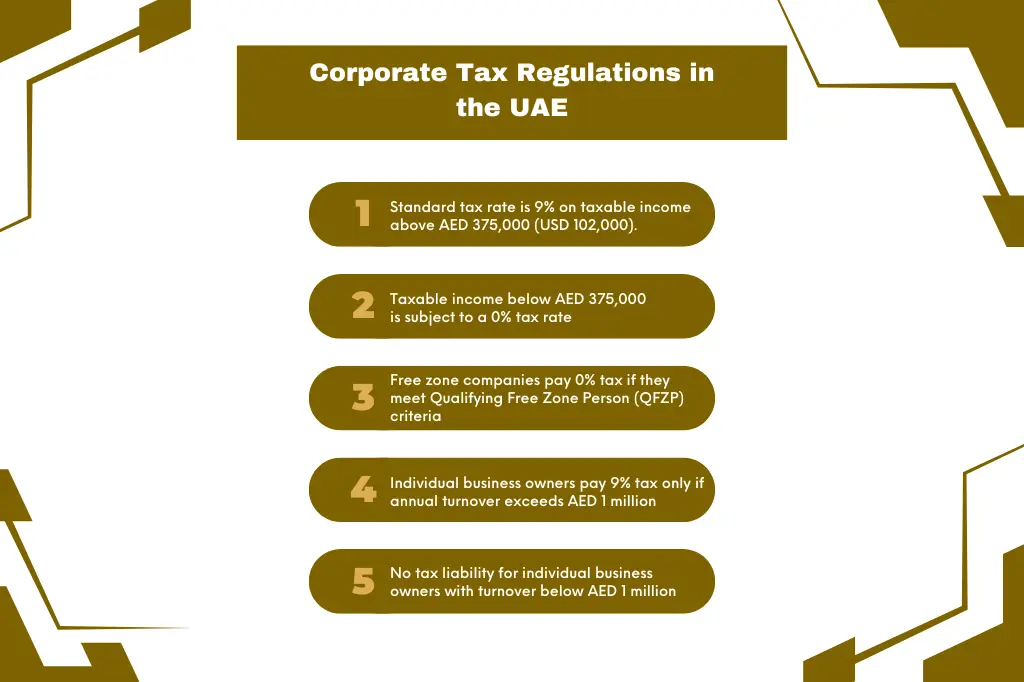
    Corporate Tax Regulations in the UAE

    • Standard tax rate is 9% on taxable income above AED 375,000 (USD 102,000).
    • Taxable income below AED 375,000 is subject to a 0% tax rate.
    • Free zone companies pay 0% tax if they meet Qualifying Free Zone Person (QFZP) criteria.
    • Individual business owners pay 9% tax only if annual turnover exceeds AED 1 million.
    • No tax liability for individual business owners with turnover below AED 1 million.

    It’s important to note that regardless of whether you need to pay taxes, have no tax liability, or are exempt, you must register for corporate tax with the UAE Federal Tax Authority (FTA) and obtain your Corporate Tax Registration number. The administrative penalty for non-registration is AED 10,000.

    UAE Corporate Tax for Free Zone Companies

    The new corporate tax framework has specific considerations for companies operating in the UAE’s free zones. A free zone company can potentially benefit from the 0% tax rate on its qualifying income, provided it meets the criteria to be classified as a Qualifying Free Zone Person (QFZP).

    What is a Qualifying Free Zone Person (QFZP)?

    A QFZP is a business entity registered within a UAE free zone that meets the following criteria set by the UAE Corporate Tax Law:

    • Has significant operations within the free zone.
    • Earns income primarily from qualifying activities carried out within the free zone or outside the free zone (Qualifying Income).
    • Chooses not to opt for the standard UAE Corporate Tax system.
    • Follows strict transfer pricing rules for transactions between related companies.
    • Maintains detailed records and financial statements.

    To qualify for the 0% tax rate, a free zone company must first register for corporate tax. Once you have the corporate tax number, you need to submit the application for Qualifying Person before your financial year ends.

    Tax Compliance and Filing Requirements for Businesses in the UAE

    Businesses subject to corporate tax in the UAE have specific responsibilities to ensure compliance with the new regulations. These include:

    Registration:
    Companies must register for corporate tax with the designated authorities, such as the Federal Tax Authority (FTA).

    Record-Keeping:
    Maintain proper accounting records that accurately reflect income and expenses, as well as supporting documentation for tax purposes.

    Tax Filing:
    Accurately file tax returns within the specified deadlines, which may include annual corporate tax returns, transfer pricing documentation, and other required filings.

    Tax Payment:
    Timely payment of any corporate tax due based on the filed tax returns.

    Failure to comply with these requirements can result in penalties of up to AED 10,000 depending on the violation.

    When to File Corporate Tax Returns in the UAE

    Under Article 48 of the Federal Decree Law 47, businesses operating in the UAE are required to submit their corporate tax returns no later than 9 months after their fiscal year ends, unless a different timeline is specified.

    Based on that, the upcoming corporate tax return deadlines for the financial year 2024 are as follows:

    – For the financial year July 2023 to June 2024, you need to file your corporate tax return by 31 March 2025.
    – If the financial year is from January 2024 to December 2024, you need to submit the return by 30 September 2025.

    Simplify Your Corporate Tax Registration and Returns in the UAE

    Navigating the complexities of corporate tax in the UAE can be challenging. Ensuring compliance with the new regulations requires meticulous planning and expert knowledge.

    To streamline your corporate tax registration and filing process, consider consulting with DXB-VIP. Contact us for a tailored consultation or leave a comment below to share your thoughts.